When our team got a call in 2000 asking if we designed for healthcare, we didn’t know what a proton therapy center was. That conversation launched a journey that has spanned two decades and established our firm as the architects behind more proton therapy centers than any other globally.
The projects we’ve completed are innovations that changed how the entire industry thinks about proton therapy design. From bringing treatment floors out of basements to introducing space-saving sliding shielded doors, these facilities have brought solutions to challenges that didn’t have answers when we started.
This is the story of the first set of projects that defined proton therapy architecture in the United States.
Hampton University Proton Cancer Institute: Where It All Began
Location: Hampton, Virginia
Significance: 8th proton center in the US, one of the largest free-standing facilities in the world
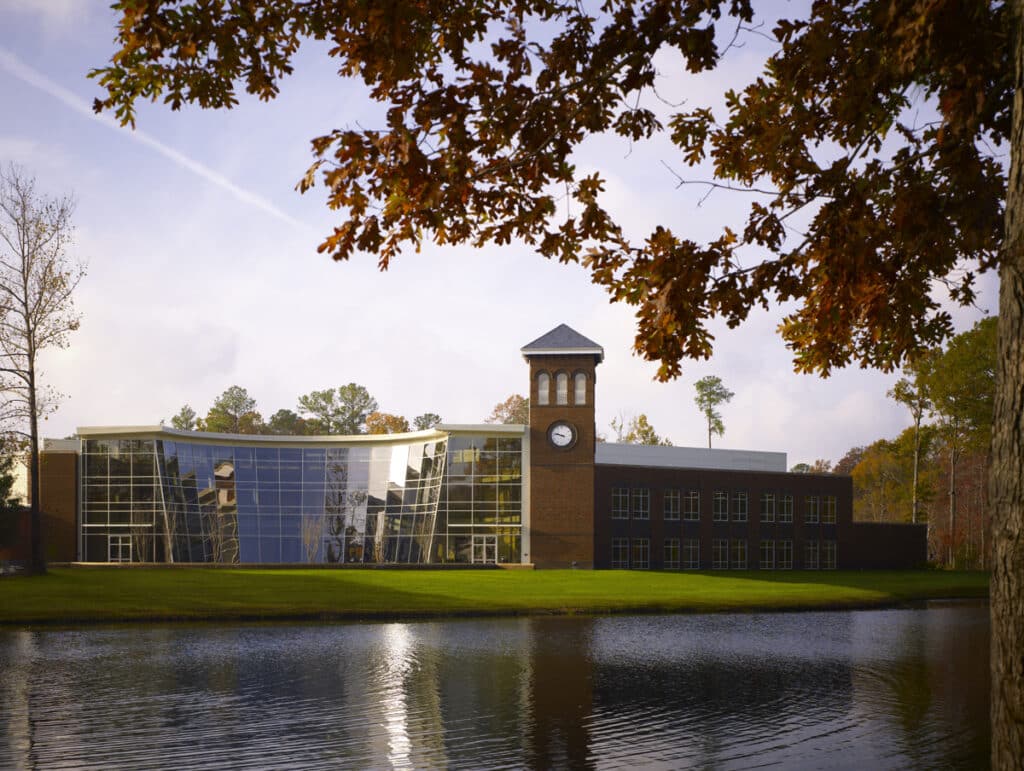
When Dr. William R. Harvey assembled a team to design what would become the Hampton University Proton Cancer Institute, we knew we were entering uncharted territory. In 2000, there were only five proton therapy centers operating in the entire country. No one on our team had worked on proton therapy before.
So we did what would become our go-to research approach: we traveled. We visited all five existing centers across the United States and studied facilities in Europe. At each location, we asked the same questions: What did you learn? What would you do differently? What challenges did you face?
Those conversations shaped everything that followed.
Hampton’s design introduced an innovation that seems obvious now but was revolutionary at the time: we lifted the treatment floor out of the basement. Every existing proton center we’d visited placed treatment rooms below grade, following the model of traditional radiation therapy facilities. Patients descended into basements for their daily treatments.
We questioned that assumption. Why did proton therapy need to happen underground?
The answer was tradition, not necessity. So we designed Hampton with the treatment floor at grade level, surrounded by windows with views of the beautiful forested setting. Patients could access treatment on a single floor, walking through spaces filled with natural daylight.
The biggest technical challenge was groundwater. Hampton’s site conditions made below-grade construction problematic anyway, reinforcing our decision to build up rather than down. The project took five years from planning to completion, and when it opened, it showed that proton therapy could happen in a healing environment that felt nothing like a basement bunker.
Today, most proton centers follow Hampton’s lead. Daylight, views, and single-floor patient circulation have become standard, but they weren’t when Hampton opened. This project proved that innovative design could improve both patient experience and construction efficiency simultaneously.
Covenant Health Thompson Proton Center: Cost-Effective Innovation
Location: Knoxville, Tennessee
Significance: Introduced sliding shielded doors, became the least costly center per square foot in the world

The Thompson Proton Center, originally designed for Provision CARES Proton Therapy Center, presented a clear challenge: deliver a world-class proton therapy facility within a strict budget on a constrained site. The location nestled beautifully into the Dowell Springs campus, but the site wasn’t very deep, and we were building into the side of a hill.
Being prudent with the building design meant rethinking every assumption about how proton therapy centers should be configured. The result became the least costly proton center per square foot of any facility in the world—not through compromises in quality, but through genuine innovation.
The most significant breakthrough was introducing bi-parting sliding shielded doors in place of traditional maze entrances to treatment rooms. These doors—at least five feet thick and weighing multiple tons—saved enormous amounts of space by eliminating the long, winding corridors that had been standard in every previous proton center.
Traditional mazes were used because they blocked radiation through geometry rather than requiring additional shielding. But they consumed valuable square footage and added construction costs. Our sliding doors provided the same radiation containment in a fraction of the space.
This was the first time these doors were used in proton therapy anywhere in the world. The innovation required solving complex engineering challenges—the doors hang from above, creating what we now call the “no fly zone” for utilities, and the mechanisms supporting tons of moving weight needed to operate reliably for decades.
Today, most new proton centers analyze whether sliding shielded doors make sense for their sites. Where space is highly constrained, these doors provide a space-saving alternative that can reduce both construction costs and the building’s overall footprint. The innovation that started in Knoxville has become an industry-standard option.
The facility was designed with two separate proton systems—two IBA gantries that opened in 2014, plus two additional vaults for future development of ProNova’s SC360 system. This forward-thinking approach allowed the center to expand its treatment capabilities as technology evolved.
Emory Proton Therapy Center: Visual Connection and Public Art
Location: Atlanta, Georgia
Significance: Showcased how proton centers could achieve architectural expression despite massive concrete requirements
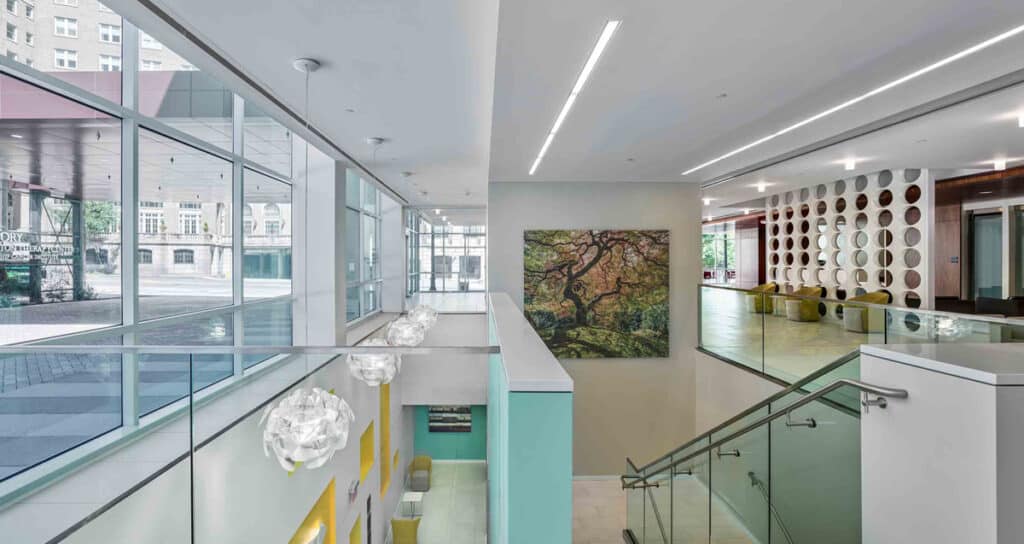
Emory Proton Therapy Center wanted something different from previous proton therapy centers—a facility with a visual connection to its surroundings and architectural presence beyond the functional requirements of radiation containment.
The L-shaped site presented both opportunities and constraints. We had massive concrete walls required for radiation shielding, which typically create blank, fortress-like facades. But we were determined to soften that institutional character.
Our approach incorporated public art on prominent concrete walls, transforming necessary structural elements into campus features. We added glass and fenestration wherever the treatment vault geometry allowed, creating visual connections between interior spaces and the landscape beyond.
A courtyard entrance area became the project’s centerpiece, providing a welcoming arrival experience that contrasted with the technical complexity happening inside. Patients and families entered through spaces that felt open and connected rather than closed off and clinical.
Emory proved that proton therapy centers could achieve architectural expression while meeting the rigorous technical requirements these facilities demand. The design balanced the precision engineering of particle accelerators with the human scale and visual warmth that supports healing.
New York Proton Center: Site Selection and Resilient Design
Location: New York City (Harlem)
Significance: First and only proton center in New York State, innovative response to post-Hurricane Sandy building codes

The New York Proton Center taught us that sometimes the journey to find the right site is as important as the design itself. The project began with a site in Manhattan’s Financial District, then moved to Midtown, where we studied multiple locations. It shifted again to the Upper East Side, where we were told we’d need to accommodate a tower above the proton center—before that site also fell through.
Each potential location eluded the team until we reached Harlem. There, we finally found a site that could work.
But just before we started designing, Hurricane Sandy struck New York. The catastrophic flooding that followed led to major changes in building codes across the city. New regulations forced our team to lift the entire proton center a full story above ground—exactly the opposite of the below-grade approach that had been common in earlier projects.
We inverted the building, placing what would usually be basement functions at ground level and lifting treatment areas above. This created an opportunity to make stairs highly visible and convenient for patients, reinforcing the single-floor patient experience we’d pioneered at Hampton.
The facility opened in 2019 as the first and only proton center in New York State, created through a unique partnership between three world-class academic medical centers: Memorial Sloan Kettering Cancer Center, Montefiore Health System, and Mount Sinai Health System.
Utilizing the Varian ProBeam system, the center houses a 250 MeV superconducting cyclotron particle accelerator supporting three rotating gantries and one fixed beam room. The design prioritizes patient well-being and comfort by incorporating natural materials and blending artificial and natural lighting. The facility’s thoughtful layout enhances efficiency, allowing doctors and technicians to work seamlessly.
Our work on the New York Proton Center extended beyond full-service design. We conducted extensive feasibility studies analyzing site conditions, financial parameters, and operational requirements across multiple locations. This due diligence—evaluating whether each potential site was buildable and sustainable—ultimately led us to the right location and saved the project from proceeding with sites that would have presented insurmountable challenges.
The New York Proton Center highlights everything we’ve learned about adaptability. When codes changed, we adapted. When sites didn’t work, we kept searching. When constraints emerged, we found innovative solutions. The result is a facility that serves the most densely populated region in the United States with state-of-the-art proton therapy.
Looking Ahead
These four projects—Hampton, Knoxville, Emory, and New York—highlight foundational innovations in proton therapy design. They introduced concepts that have become industry standards: grade-level treatment floors, sliding shielded doors, architectural expression balanced with technical requirements, and resilient design responding to changing regulations.
Each project taught us lessons that informed the next. The knowledge gained from bringing treatment floors out of basements at Hampton guided our approach to every subsequent project. The space-saving innovations at Knoxville created options for constrained sites nationwide. Emory’s visual connection principles showed that technical facilities could still be beautiful. New York’s journey through multiple sites and code changes proved that persistence and adaptability lead to success.
In Part 2
We’ll explore how these lessons apply to projects facing extreme constraints, multiple facility coordination, and the unique challenges of international work.
At Jessen Proton, every project builds on the accumulated knowledge of those that came before. Our experience designing the industry’s most innovative facilities means we can anticipate challenges, propose solutions, and deliver centers that work brilliantly from day one.
Questions about your proton therapy center project? Contact us to discuss how lessons from these prominent projects can inform your facility’s success.