Every proton therapy center built before 2000 was underground. Patients descended into basements for treatment, navigating maze-like corridors beneath hospital campuses. The approach seemed necessary—radiation therapy had been done in basements for decades, so proton therapy followed the same model.
Then we asked a simple question at Hampton University: Why?
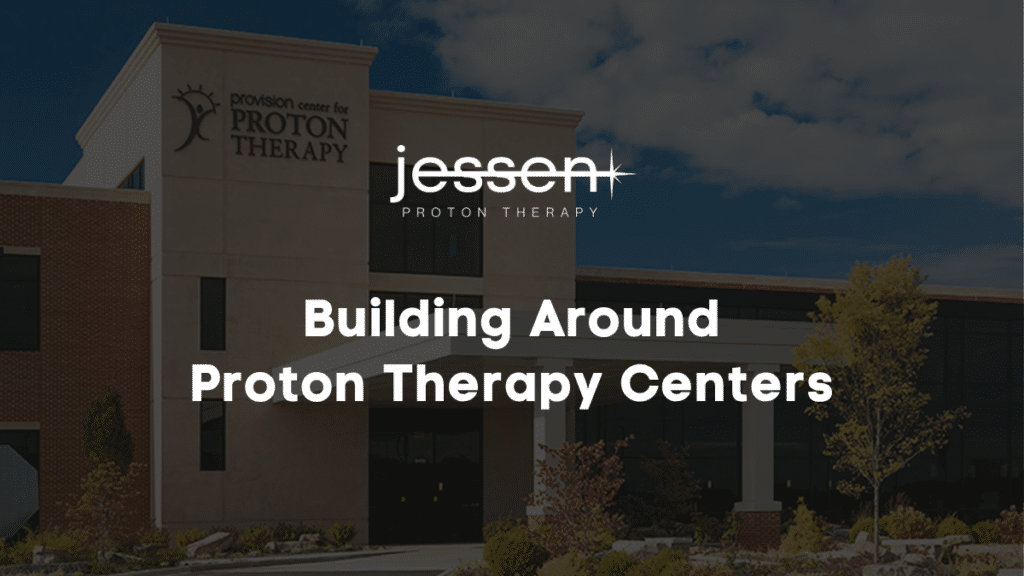
No one had a good answer. The decision to build underground came from tradition, not physics. Proton therapy didn’t require basement placement any more than it required treatment rooms to be painted green. So we designed Hampton with the treatment floor at grade level, surrounded by windows overlooking a forested setting.
Today, that decision seems obvious. But it opened a larger question that shapes every proton therapy project: Where can you build these facilities, and what can you build around them?
The answers have evolved dramatically over two decades. We’ve built proton centers above ground, below ground, with towers stacked on top, integrated into existing hospitals, and squeezed onto sites that seemed impossible. Each approach works under the right circumstances. The key is understanding which circumstances demand which solution.
When Underground Makes Sense
Despite Hampton’s innovation, some projects benefit from below-grade placement. The decision is about site conditions, integration requirements, and long-term operational goals.
Underground construction can reduce the visual impact of massive concrete structures. Shielding walls 14 feet thick create fortress-like buildings when placed above ground. Sinking them below grade can preserve campus aesthetics and maintain sightlines across medical centers.
Integration with existing facilities sometimes drives the decision. If your radiation oncology department operates two floors below ground, connecting a new proton center at that level creates seamless patient flow. Staff can move between modalities without navigating multiple floor changes. Equipment and supplies can share infrastructure.
Site constraints play a role too. Building into hillsides—as we did at the Thompson Proton Center in Knoxville—can reduce excavation costs while providing the mass of earth needed around treatment vaults. The topography does some of the shielding work that would otherwise require concrete.
But underground construction comes with challenges. Water tables can add millions to foundation costs, as nearly happened at Hampton before we redesigned the facility. Excavation depths increase with below-grade placement, extending timelines and budgets. Future equipment access becomes more complicated when you need to extract components weighing hundreds of tons from basement vaults.
The decision to build underground should be deliberate, driven by specific advantages for your site and operational model—not because it’s “how proton centers are built.”
Above Ground and Patient Experience
When we lifted Hampton’s treatment floor to grade level, the change went beyond construction efficiency. Patient experience improved dramatically.
Natural daylight reaches waiting areas and circulation spaces. Windows provide views of the landscape rather than basement walls. Wayfinding becomes intuitive when patients enter at ground level and remain on a single floor for treatment. Family members don’t navigate confusing below-grade corridors trying to find treatment rooms.
Proton therapy patients often receive treatment daily for weeks. Children undergoing pediatric proton therapy need environments that feel less clinical and more welcoming. The psychological impact of natural light and visual connection to the outside world supports healing in ways that basement facilities can’t match.
The New York Proton Center took above-ground placement further out of necessity. Post-Hurricane Sandy building codes forced us to lift the entire facility a full story above ground. We inverted the building, placing what would usually be basement functions at ground level and raising treatment areas above.
The constraints created opportunities. Stairs became highly visible and convenient. The elevated position reinforced single-floor patient circulation. Ambulance access could tuck beneath the structure. What started as a code requirement became a design advantage.
Most new proton centers now default to grade-level or above-ground placement unless site conditions or integration requirements argue otherwise. The patient experience benefits are too significant to ignore.
Building Towers Above Proton Centers
One question comes up repeatedly: Can you build above a proton center?
The answer is yes, but it requires planning from day one.
At Massachusetts General Hospital, a tower was built above the Francis H. Burr Proton Therapy Center after the original facility opened. No one anticipated needing to replace equipment decades later. Now we’re managing the world’s first major proton therapy upgrade, working around structural constraints that make equipment extraction far more challenging than it would have been with proper planning.
For the UCSF Proton Therapy Center, we’re designing a 50,000 square foot facility at the base of an eight-story tower. The difference is that we’re planning for future equipment replacement from the beginning. The proton vaults are positioned to allow access for both installation and potential extraction 20-25 years from now, without disrupting the tower above.
This forward-thinking approach means creating pathways, preserving access points, and ensuring structural elements don’t block future equipment movement. It means coordinating with the tower design team so their foundations don’t prevent our equipment extraction routes.The key lesson from Mass General is this: if you might build above your proton center later, design for that possibility now. If you’re building a tower above your proton center from the start, plan equipment extraction before you pour concrete. The construction costs for redesigning access decades later dwarf the investment in proper planning.
Integration with Existing Medical Facilities
Most proton therapy centers don’t stand alone. They connect to existing cancer centers, radiation oncology departments, and hospital campuses. How you integrate them matters enormously for operational efficiency and patient care.
At Johns Hopkins Sibley Memorial Hospital, we connected the new proton center to the existing radiation oncology department with a pedestrian bridge. The link allows staff to move between facilities seamlessly while keeping both buildings operationally independent. Patients can access either modality without navigating outdoor pathways or complex internal corridors.
The site was squeezed between active construction and a parking garage—the only remaining plot on campus. We inverted the building vertically, creating connections that wouldn’t have been possible with traditional horizontal placement.
MD Anderson’s approach to multi-building integration shows another model. An elevated pedestrian walkway connects their two proton therapy centers. While designed for patients, staff primarily use it to move between facilities. Patients typically receive all treatment in one building, but the connection provides operational flexibility and redundancy.
The lesson across these projects is that integration should serve operational goals, not follow prescribed patterns. Sometimes bridges work. Sometimes shared basements make sense. Sometimes separate buildings with clear pathways between them function better than forced physical connections.
Understanding your operational model before designing integration is critical. How will patients move through your system? Where will staff be based? What equipment and supplies need to be shared? The answers shape integration strategies more than any architectural preference.
Site Constraints That Force Innovation
Some of our most successful projects came from sites that seemed impossible at first.
Johns Hopkins had one remaining plot on campus, sandwiched between active construction and existing structures. Most teams would have declared the site unworkable. We inverted the building, created ambulance access below, and connected to adjacent facilities with a bridge. The constraints forced creative solutions that made the project better.
The Thompson Proton Center in Knoxville was built into a hillside on a site that wasn’t very deep. We used the topography to our advantage, reducing excavation while letting the hillside provide natural shielding on one side. The result became the least costly proton center per square foot in the world.
New York’s journey through multiple sites—from the Financial District to Midtown to the Upper East Side before finally settling in Harlem—taught us that persistence matters. Each site that didn’t work eliminated options and clarified requirements. When we found the right location, we knew it would work because we understood what wouldn’t.
Site constraints force you to question assumptions, consider alternatives, and often discover solutions better than what you would have designed with unlimited space and budget.
Planning for Future Decommissioning
The newest consideration in proton therapy site planning is one that didn’t exist when we designed Hampton: planning for equipment replacement decades in the future.
Our work on upgrade projects has shown that facilities built 20-25 years ago never anticipated needing to remove and replace their equipment. Getting components weighing hundreds of tons out of treatment vaults designed without extraction pathways is extraordinarily complex and expensive.
Every new project we design now includes decommissioning considerations. Where will equipment enter during installation? Could it exit the same way during replacement? If we’re building a tower above the proton center, do extraction pathways remain accessible? What structural elements need to be removable rather than permanent?
These questions don’t add significant cost during initial construction, but they can save millions during future upgrades. A removable wall section costs more than a permanent wall, but far less than demolishing a permanent wall decades later to extract equipment.
The lessons we’ve learned from upgrade projects now inform every new build.
Making the Right Decision for Your Site
Deciding where and how to build your proton therapy center depends on factors specific to your institution, location, and operational goals.
Above ground works when patient experience is a priority, site conditions allow it, and you want natural light and intuitive wayfinding. Below ground makes sense when integrating with existing below-grade facilities, when site topography supports it, or when campus aesthetics require reducing visual impact.
Building towers above proton centers is possible but requires planning for future equipment extraction from day one. Integrating with existing medical facilities should serve your operational model, not follow predetermined patterns.
Site constraints often force the most innovative solutions. The “impossible” site sometimes produces the best design because it eliminates options that seemed safe but weren’t optimal.
At Jessen Proton, we’ve built proton therapy centers in every configuration imaginable. We know which approaches work under which circumstances because we’ve solved these challenges dozens of times across different sites, institutions, and operational models.
The right answer for your project depends on your specific conditions. But the wrong answer—building underground because “that’s how it’s done” or avoiding constrained sites because they seem difficult—comes from not questioning assumptions.Questions about site selection and integration for your proton therapy center?
Contact us to discuss how two decades of experience across every site type can inform your project’s success.