Following the foundational innovations at Hampton, Knoxville, Emory, and New York, our team faced increasingly complex challenges: extremely constrained urban sites, multi-building campus coordination, and added demands of international projects where language, codes, and construction practices all differed from our domestic experience.
These projects pushed us to develop new solutions—and taught us that expertise in proton therapy design means solving problems that don’t have precedents.
Johns Hopkins Proton Therapy Center: Designing Within Constraints
Location: Washington, D.C. (Sibley Memorial Hospital)
Project Size: 80,000 square feet
Significance: Solved extreme site constraints while creating one of few dedicated pediatric proton therapy programs
The Johns Hopkins Proton Therapy Center at Sibley Memorial Hospital presented constraints that would have stopped less experienced teams before design even began.
We received concept floor plans meant for a specific budget. The plans didn’t work. There was no clinic space. No dressing rooms. No proper entrance. The proposed layout wouldn’t function as an operational proton therapy center.
The site itself was the only remaining plot on Sibley’s campus—squeezed between the active construction of a new bed tower and a four-story parking garage. We had to build a complete proton therapy center in a space that barely seemed large enough to accommodate the treatment vaults, let alone the supporting clinical functions.
Our solution inverted the typical proton center organization. Treatment vault pits went at ground level. The second floor became the patient treatment level—where patients would receive care in spaces connected to the clinical environment. The third floor housed office space and administrative areas.
This vertical organization did something critical: it lifted the building above ground, creating space for ambulance access below. It also allowed us to connect the new proton clinic to Sibley’s existing radiation oncology department with a pedestrian bridge, integrating the facilities operationally.
Johns Hopkins and Children’s National collaborated to create one of the few dedicated pediatric proton therapy programs in the country. The design needed to serve both adult and pediatric populations, requiring careful attention to creating spaces that felt welcoming for children while maintaining the clinical rigor these facilities demand.
The project proved that even the most constrained sites can accommodate proton therapy when design responds creatively to limitations rather than accepting them as barriers.
MD Anderson Proton Therapy Center: Multi-Building Integration
Location: Houston, Texas
Project Size: 80,000 square feet, 4 gantries
Significance: Created the world’s largest proton therapy center through the integrated design of two buildings
MD Anderson’s second proton therapy center addressed a unique challenge: how do you expand an institution’s proton therapy capacity while maintaining operational cohesion with an existing facility?
The new two-story building centers around four full-size Hitachi proton gantries, two featuring CT on rails within the treatment rooms—incorporating the latest technology for image-guided treatment. But the real innovation was in how the new building related to the existing proton treatment facility.
The biggest challenge was logistical: How do you get patients to move between two proton therapy centers efficiently? How do you operate them as a unified program rather than separate facilities?
Our solution connected the buildings with an elevated pedestrian walkway. Interestingly, while this connection was designed with patients in mind, it’s primarily used by staff moving between facilities. Patients typically receive all their treatment in one building or the other.
The original plan was to upgrade the first center after the second opened. As upgrade projects have evolved into a new discipline within proton therapy design, MD Anderson’s strategy has adapted. Now, the original center serves primarily as administrative headquarters while the second center handles most treatment. Both buildings remain in shared use, operating cohesively as one program.
Our team is now working on upgrading the original MD Anderson center—part of our growing experience with proton therapy center upgrade projects that are teaching entirely new lessons about decommissioning, equipment replacement, and facility adaptation.
Together, these structures create the largest proton therapy center in the world, solidifying MD Anderson’s standing as a global leader in cancer treatment. The multi-building approach provides flexibility and capacity to serve patient volumes that a single facility couldn’t accommodate.
UCSF Proton Therapy Center: Mission Bay and Beyond
Location: San Francisco, California
Project Size: 50,000 square feet, 3 gantries
Significance: First proton center in San Francisco, demonstrating advanced planning for future equipment extraction
Since 2017, we’ve been working with UCSF as the owner’s representative and proton subject matter expert to develop a new proton therapy center in San Francisco. This project shows how our role has evolved beyond architectural services to include strategic advisory throughout the development process.
Early studies examined several sites on or near UCSF’s Mission Bay campus. We marched all around Mission Bay analyzing options. Later phases studied additional sites off campus and at Mount Zion. Currently, the project centers on an off-campus site one mile south of UCSF Mission Bay in San Francisco’s Dogpatch district.
One of the biggest challenges has been the bedrock. We’ve had to dig deep into San Francisco’s geology to make the project work—a reminder that site conditions can add substantial complexity and cost to proton therapy construction.
The project, currently in design, consists of a 50,000 square foot proton center at the base of an eight-story tower. We’re applying lessons learned from our upgrade projects—particularly our experience at Massachusetts General Hospital—to position the proton vaults carefully. Equipment access for both initial installation and potential future extraction is being designed in from the beginning, without disruption to the tower above.
This forward-thinking approach means that 20-25 years from now, when proton therapy technology has evolved again, UCSF won’t face the challenges we’re currently solving at facilities that never anticipated equipment replacement.
Our work spans multiple service areas:
Project Management – We oversee the project from initial planning through first patient treatment, coordinating specialized teams and managing the complex multi-year timeline these facilities demand.
Owner Representation – We advocate for UCSF’s interests throughout the development process, ensuring that equipment selections, site decisions, and budget allocations align with their long-term operational goals.
Subject Matter Expert Advisory – As the world’s leading proton therapy architects, we guide decisions with experience that saves time, money, and prevents costly mistakes.
Feasibility Studies – We analyzed site conditions, financial parameters, and operational requirements across multiple potential locations to determine which option was truly buildable and sustainable.
This level of involvement reflects how proton therapy projects benefit from expert guidance across all phases, not just during design and construction.
International Projects: Global Collaboration and Local Knowledge
Our experience extends beyond the United States to international projects that taught us entirely different lessons about collaboration, communication, and the universal nature of physics.
International proton therapy projects face challenges specific to working across borders: language barriers, unfamiliar building codes, different bidding processes, and entirely different approaches to how design and construction teams are assembled and managed.
Our approach has been consistent: align with local architects who bring knowledge of their country’s regulations, construction practices, and cultural expectations. We bring proton therapy expertise. They bring local expertise. Together, we create facilities that meet both the universal physics requirements of particle accelerators and the specific requirements of each location.
The physics doesn’t change based on location. Proton therapy has to be precise, or it won’t work—whether you’re building in California, Texas, or China. A proton beam traveling at two-thirds the speed of light requires the same shielding and the same dimensional tolerances regardless of where the facility is located.
Every international project we’ve completed has been successful using this mixed-team approach. We wouldn’t do it any other way. The combination of specialized proton knowledge and local construction expertise is essential.
Hefei Ion Medical Center: Lessons in Project Pacing
Location: Hefei, Anhui Province, China
Project Size: 365,000 square feet
Significance: Key player in China’s development of domestically produced proton therapy technology
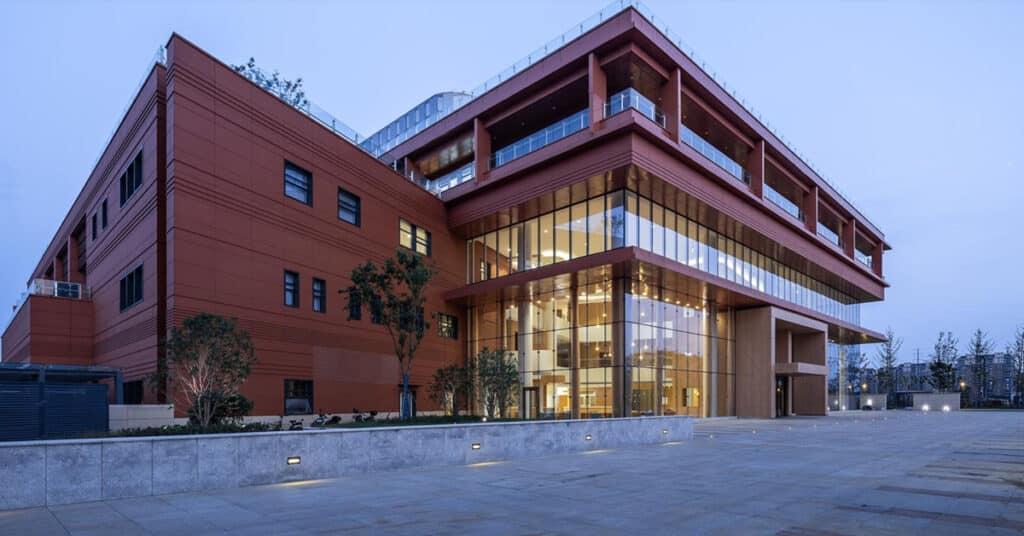
The Hefei Ion Medical Center project taught us about the dramatically different pace of construction in international markets—particularly in China, where project timelines can move faster than American teams often expect.
We worked with a local architect, as we do on all international projects. The challenge emerged when we didn’t fully appreciate how quickly the Chinese client wanted to begin construction. They started pouring concrete before drawings were complete—an unthinkable move in the United States that highlighted different cultural expectations about construction sequencing.
We had concerns. We knew we needed to achieve a balance between their desire for speed and our responsibility to ensure the facility would work correctly. The physics requirements couldn’t be compromised, even under pressure to move faster.
The project required constant communication, clarification, and sometimes negotiation about which elements could proceed in parallel and which absolutely required completed design before construction began. It was a learning experience in managing different expectations about project pacing while maintaining the precision these facilities demand.
Completed in 2020, the first phase consists of a four-story comprehensive cancer center including three Varian ProBeam gantries, two LINACs, 40 inpatient beds, and a suite of diagnostic imaging equipment. The second phase was pre-planned into the development and will be home to China’s first carbon therapy center—an even more advanced form of particle therapy.
The project succeeded because we maintained the essential proton therapy requirements while adapting to local construction approaches where possible. That balance—knowing what’s negotiable and what isn’t—defines successful international collaboration.
The Universal Nature of Precision
What international projects reinforce is that proton therapy design is fundamentally about physics, not about cultural preferences or local traditions. The treatment vault dimensions, the shielding thickness, the equipment tolerances—these are determined by particle physics and radiation safety, not by building codes or regional practices.
Language may change. Codes may vary. Construction methods may differ. But the requirement for millimeter-level precision doesn’t change. The need for concrete walls 14 feet thick doesn’t change. The challenge of moving equipment weighing hundreds of tons doesn’t change.
This universal nature of the technical requirements is why specialized proton therapy expertise translates across borders. The lessons we’ve learned from domestic projects apply internationally—and lessons from international projects inform our domestic work.
The Accumulated Knowledge
Each project we’ve described—from Johns Hopkins’ constrained site to MD Anderson’s multi-building integration, from UCSF’s forward-thinking extraction planning to Hefei’s rapid construction pace—adds to our institutional knowledge about what works and what doesn’t.
The construction costs for proton therapy centers remain substantial—often $250+ million for new facilities—but our accumulated experience means we can anticipate challenges, propose solutions, and deliver facilities that work brilliantly from day one.
Whether we’re designing a new facility, managing a project as owner’s representative, conducting feasibility studies across multiple sites, or guiding an international collaboration, the expertise remains the same: understanding the unique requirements of proton therapy and applying decades of lessons learned to each new challenge.
At Jessen Proton, that expertise guides every project. Because in proton therapy, experience isn’t just valuable—it’s essential.
Questions about your proton therapy center project? Contact us to discuss how lessons from these prominent projects can inform your center’s success.